
|
Home >> Studio >> Step-by-Step--The Making of a Llama
|
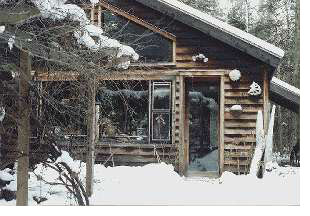 Welcome to my studio, the home of Alice's Animals. Here I design and create the tiny creatures that fill the pages of the catalog and gallery. The studio hides in a grove of pine trees in rural northern Minnesota, and inspiration lies just a few feet outside the many large windows. A young deer naps under the grape arbor, squirrels and raccoons misappropriate the seeds meant for the numerous birds, and a bear leaves its giant pawprints on the studio door. Inspiration is found indoors as well; I share the studio with my sister Billie Barthelemy, who is a fine fiber artist in her own right. Though our works are different, we share a love for fine detail and meticulous craftsmanship, and for the lifestyle we've chosen. Welcome to my studio, the home of Alice's Animals. Here I design and create the tiny creatures that fill the pages of the catalog and gallery. The studio hides in a grove of pine trees in rural northern Minnesota, and inspiration lies just a few feet outside the many large windows. A young deer naps under the grape arbor, squirrels and raccoons misappropriate the seeds meant for the numerous birds, and a bear leaves its giant pawprints on the studio door. Inspiration is found indoors as well; I share the studio with my sister Billie Barthelemy, who is a fine fiber artist in her own right. Though our works are different, we share a love for fine detail and meticulous craftsmanship, and for the lifestyle we've chosen.
 Perhaps "chosen" isn't exactly the right word, as my current work began over twenty-five years ago as the result of a happy accident. While attending college in preparation for a career in graphic design, I decided to sew a Raggedy Ann doll for a friend who had recently had a baby. I'd attempted in high school to sew my own clothing, and though that attempt ended in miserable failure I still had a very old treadle sewing machine. I made the doll using rather non-traditional fabrics and colors, and within days after presenting the gift I found that I had "customers." In the months thereafter I created every possible variation on the Raggedy style---lime green clothing, long blonde hair, blue eyes, and finally a black version which was purchased at a shop in Minneapolis and taken home to England as a gift for Princess Margaret's daughter. This was quite a thrill for a young college student, and may have sealed my fate. Perhaps "chosen" isn't exactly the right word, as my current work began over twenty-five years ago as the result of a happy accident. While attending college in preparation for a career in graphic design, I decided to sew a Raggedy Ann doll for a friend who had recently had a baby. I'd attempted in high school to sew my own clothing, and though that attempt ended in miserable failure I still had a very old treadle sewing machine. I made the doll using rather non-traditional fabrics and colors, and within days after presenting the gift I found that I had "customers." In the months thereafter I created every possible variation on the Raggedy style---lime green clothing, long blonde hair, blue eyes, and finally a black version which was purchased at a shop in Minneapolis and taken home to England as a gift for Princess Margaret's daughter. This was quite a thrill for a young college student, and may have sealed my fate.
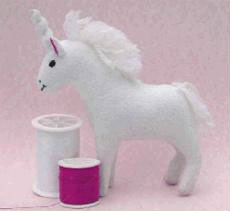
 My first subject from the animal world was a three foot tall stuffed goose, which was a commission from the same Twin Cities gift shop. It was made of a cotton print fabric, and had huge floppy feet. After struggling through several of these, I realized that the large size was, for me, unwieldy and somewhat intimidating, and I designed a six-inch version of the goose, which was much more to my liking. Ducks followed, and loons, and little horses and teddy bears. A representative from LadySlipper Designs, a cottage industry in northern Minnesota, saw my work, and asked that I create a unicorn for them to sell. I agreed, and sewed and sold hundreds of them. The original design was about six inches tall, and it was made from white suedecloth, with a fluffy yarn mane and tail. More little stuffed animals followed---rabbit, squirrel, skunk---and as time passed, my designs grew ever smaller and more detailed. My subject matter is endless; the world is full of fascinating birds and beasts, and I continue constantly to design new creatures for my menagerie. My first subject from the animal world was a three foot tall stuffed goose, which was a commission from the same Twin Cities gift shop. It was made of a cotton print fabric, and had huge floppy feet. After struggling through several of these, I realized that the large size was, for me, unwieldy and somewhat intimidating, and I designed a six-inch version of the goose, which was much more to my liking. Ducks followed, and loons, and little horses and teddy bears. A representative from LadySlipper Designs, a cottage industry in northern Minnesota, saw my work, and asked that I create a unicorn for them to sell. I agreed, and sewed and sold hundreds of them. The original design was about six inches tall, and it was made from white suedecloth, with a fluffy yarn mane and tail. More little stuffed animals followed---rabbit, squirrel, skunk---and as time passed, my designs grew ever smaller and more detailed. My subject matter is endless; the world is full of fascinating birds and beasts, and I continue constantly to design new creatures for my menagerie.
I begin the design process by drawing a simple animal profile on paper. I cut out the shape and then draw matching pieces that will make the animal three-dimensional. I then cut the pieces from fabric, sew them together, and stuff the form that results. Then begins a process of trial and error; if the shape is not right, I re-draw whichever pattern piece appears out of proportion and start over. Sometimes, though rarely, the shape appears perfect on the first try. More often, I will have to re-do it three or four times before I'm satisfied with the result. Occasionally I throw it against the wall and give up. When I'm finally happy with the basic shape, I begin to add the details---ears, eyes, tail. Only then will I know if the pattern I've created will do justice to the animal I'm attempting to emulate. The very small scale demands perfection, as mistakes are magnified, and an error of one sixteenth of an inch appears very large. 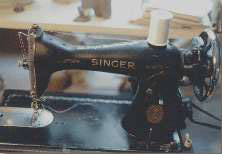 When the basic design is completed I move on to producing the animals for sale. My tools are very simple. I sew on an electric machine that was made by Singer in the 1950's; it does nothing but go forward and backward, and is perfect for my purposes. Scissors, needles, pins, and a fine instrument for turning pieces right side out after they are sewn are the basic tools of my trade. I use mostly synthetic materials, as they allow me to work with a very small seam allowance and will not unravel or rip apart as easily as natural fibers. When the basic design is completed I move on to producing the animals for sale. My tools are very simple. I sew on an electric machine that was made by Singer in the 1950's; it does nothing but go forward and backward, and is perfect for my purposes. Scissors, needles, pins, and a fine instrument for turning pieces right side out after they are sewn are the basic tools of my trade. I use mostly synthetic materials, as they allow me to work with a very small seam allowance and will not unravel or rip apart as easily as natural fibers.
I'd like to invite you to follow me through a step-by-step creation of one of my animals. I've chosen a llama, as it is a relatively simple design which also shows the importance of detail. Click here. 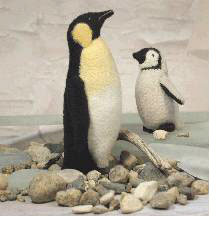 In recent years I've sold my little animals almost exclusively at art fairs. This has made for an exciting marketplace as well as a fascinating lifestyle, combining freedom with a certain amount of insecurity. Both the cameraderie among the artists and the input and praise from customers are inspiring and fulfilling. My participation in these shows has blessed me with a loyal group of people who collect my work. They make their annual pilgrimages to my booth to add to their collection, some of them carrying lists of pieces they already have to avoid duplication. I greatly enjoy hearing their stories about how they use and display the animals they purchase. Some are tucked safely away, to be brought out only for special occasions; to trim a Christmas tree, to celebrate the arrival of spring or a special birthday. Others are displayed year-round in shadow boxes or glass cabinets, and, in one case, under a Mason pint jar. An especially tiny piece occasionally finds its way into a dollhouse. Collectors with a playful nature use stones, bits of moss, or any of a multitude of small objects to create a little environment which brings the animals to life. In recent years I've sold my little animals almost exclusively at art fairs. This has made for an exciting marketplace as well as a fascinating lifestyle, combining freedom with a certain amount of insecurity. Both the cameraderie among the artists and the input and praise from customers are inspiring and fulfilling. My participation in these shows has blessed me with a loyal group of people who collect my work. They make their annual pilgrimages to my booth to add to their collection, some of them carrying lists of pieces they already have to avoid duplication. I greatly enjoy hearing their stories about how they use and display the animals they purchase. Some are tucked safely away, to be brought out only for special occasions; to trim a Christmas tree, to celebrate the arrival of spring or a special birthday. Others are displayed year-round in shadow boxes or glass cabinets, and, in one case, under a Mason pint jar. An especially tiny piece occasionally finds its way into a dollhouse. Collectors with a playful nature use stones, bits of moss, or any of a multitude of small objects to create a little environment which brings the animals to life.
And finally, a word about care and feeding. Feeding your collection should present no problem, but you may wish to exercise a bit of care to ensure that your animals remain in pristine conditions for many years to come. Try to display them away from direct sunlight, as the colors may fade over time. I suggest keeping them out of the reach of dogs and cats, as I occasionally hear tales of tiny pet-related tragedies. Also, most of my animals are not appropriate for small children and may be damaged by too much enthusiastic handling. A piece of tape will remove dust and lint, and some spots may be removed by rubbing gently with a clean damp cloth. An ounce of protection is worth a pound of cure, however, and I recommend that you protect your collection in a cabinet. I hope you've enjoyed learning a little about Alice's Animals. Thanks for visiting! |